A Midterm Review Built Around Questions, Not Pages
A question-based midterm review turns BA course headings into focused prompts, helping you identify gaps and decide exactly what to revisit before the exam.
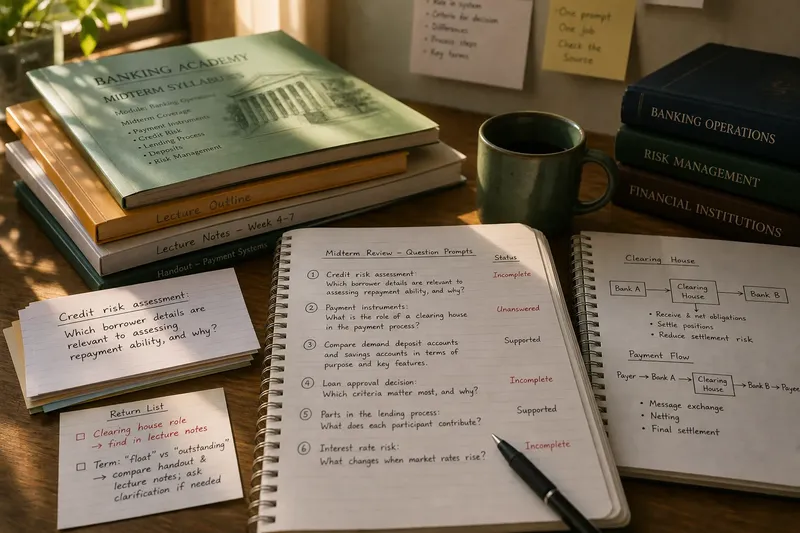
The common midterm mistake is to count pages reread as material reviewed. At the Banking Academy (BA), that can leave you with familiar-looking lecture notes but no clear record of what you can explain without them. A question-based midterm review turns course headings into retrieval prompts and makes unanswered material visible.
Why build the review from course documents?
A syllabus, lecture outline, handout, and annotated slide deck do different jobs. The syllabus sets the examinable boundary; lecture materials show which terms and distinctions the class actually used. Treat those documents as the review’s working objects, not as a stack to copy into a cleaner stack.
Start with substantial headings from the midterm syllabus or lecture outline. For each one, write a prompt that matches its form: a process heading calls for stages, a comparison calls for differences, and a decision heading calls for relevant criteria. Keep the original heading beside the prompt so the question remains tied to the course’s vocabulary.
- Observation: The heading names a process. If the lecture gives an order of actions, then ask for the stages in sequence; otherwise ask what changes from start to finish.
- Observation: The heading names two related terms. If the notes distinguish them by function, then ask what each does; otherwise ask which features separate them in the course material.
- Observation: The heading names a decision or assessment. If the lecturer lists criteria, then ask which criteria matter and why; otherwise ask what information the decision depends on.
- Observation: The heading names a system with several participants. If the source assigns roles, then ask what each participant contributes; otherwise ask how the parts connect.
- Observation: A handout and lecture notes use different labels. If they refer to the same concept, then record both labels and check the assigned source; otherwise keep them as separate prompts until the distinction is clear.
- Observation: A heading is so broad that it invites an essay. If the source contains a specific process, distinction, or purpose beneath it, then narrow the prompt to that subject; otherwise ask the instructor what scope is intended.
Use the wording taught in class where it matters. A polished synonym can be less useful than the slightly awkward term on the lecture slide if that term carries a specific meaning in the module.
How can you keep prompts answerable?
“Explain banking” asks for a textbook, not a review answer. Narrow a broad heading by naming the process, comparison, relationship, or decision the course discusses.
Give each prompt one main job. If a question asks for a definition, a comparison, and an example all at once, split it; otherwise, a missing detail can hide inside an answer that looks complete.
Imagine your lecture outline has the heading “Credit risk assessment,” and the notes list borrower information without explaining its purpose. Write: “Which borrower details are relevant to assessing repayment ability, and why?” With the notes closed, an answer that names income but cannot connect it to repayment identifies a specific gap to check, rather than a vague need to study more.
Put the prompt on an index card, in a notebook margin, or in a plain document. Keep the source nearby for checking, but closed during the first attempt.
What should one review session contain?
Choose one bounded part of the midterm material: a lecture, a related cluster of headings, or a clearly marked syllabus section. Gather only the documents needed for that boundary, such as the syllabus page, lecture notes, and assigned reading used to verify an answer.
Work through the session in this order:
- Select substantial headings from the chosen section and keep their source document visible.
- Write one direct prompt for each heading, using the kind of answer the course expects.
- Close the notes and answer each prompt aloud or in brief written points.
- Reopen the relevant source and mark each answer as supported, incomplete, or unanswered.
- Write the exact missing point beside each incomplete prompt, then stop at the boundary you selected.
Brief answers make omissions easier to see than a page of prose written before checking what you remember.
How should you sort unanswered midterm review questions?
A blank answer, a confused term, and a disputed note call for different next actions. Record the reason a prompt remains open instead of filing every difficulty under “review.”
- Observation: Nothing comes to mind. If the source gives a clear explanation, then read that passage and retry with the notes closed; otherwise ask the instructor or consult the assigned material.
- Observation: You recall the main idea but miss a condition or stage. If the source names the missing detail, then add that detail beside the prompt and retry; otherwise mark the answer incomplete and seek clarification.
- Observation: The prompt could be read in more than one way. If the course heading or lecture explanation settles the scope, then rewrite the prompt to match it; otherwise ask which distinction the course expects.
- Observation: Two course documents appear to conflict. If the assigned source resolves the difference, then update the answer and note the source; otherwise keep the conflict open and request clarification rather than choosing a wording at random.
- Observation: A prompt combines several demands. If its parts can be answered separately, then split it into focused questions; otherwise narrow it to the central demand in the course heading.
- Observation: An answer is supported by the notes but uses a different term. If the source treats the terms as equivalent, then record the course term beside your wording; otherwise check the distinction before marking the answer complete.
Say you have six prompts from a lecture on payment instruments, and two remain open: one asks for a clearing house’s role, while the other concerns a term used differently in a handout and your notes. First, you mark the clearing-house prompt “find role in lecture notes,” then check the assigned section and retry with the notes closed. Next, you keep both versions of the disputed term beside its prompt and compare the handout with the lecture wording; if they still conflict, you ask for clarification. The resulting list has one answer to verify and one terminology question to resolve, rather than a general instruction to reread the lecture.
Keep the open questions in a small return list. Preserve the prompt and the reason it remains open; copying whole passages merely gives the paperwork a new address.
Which midterm review questions come up often?
Should I write answers before checking my notes?
Try to retrieve the answer first, even if you can write only a few points. Then compare those points with the relevant course material; reading beforehand can make recognition look like recall.
What if I cannot turn a heading into a question?
Check the lecture explanation beneath it and identify whether the subject is a definition, process, comparison, or purpose. Use that form to write a prompt; if the heading remains ambiguous, preserve its wording and ask the instructor what scope is intended.
How many prompts should I prepare?
Cover the substantial headings within the boundary you chose, without making a separate card for every sentence or minor label. If you cannot answer and check the prompts within the session’s boundary, reduce the selection rather than racing through it.
Should an unanswered prompt stay on the same list?
Yes, if the list records the specific gap and the next action. Keep the original question, add what remains unclear, and return to the relevant source before trying again.
What makes a second pass useful?
Begin the return session with the open question, not with a default reread of the entire lecture. Find the passage that addresses the missing point, close the notes, and try again; if uncertainty remains, leave the prompt open and identify what needs clarification.
A question-based midterm review works as a record of which course ideas you can retrieve and which still need attention. Keep prompts connected to BA course documents, make the review boundary visible, and let each open item determine the next action. That is a more useful measure of progress than the thickness of a pile of notes.