A Ledger Page Classroom Example That Separates Entries From Inference
Use a ledger page classroom example to distinguish recorded entries from inference, annotate missing context, and read a classroom form without inventing details.
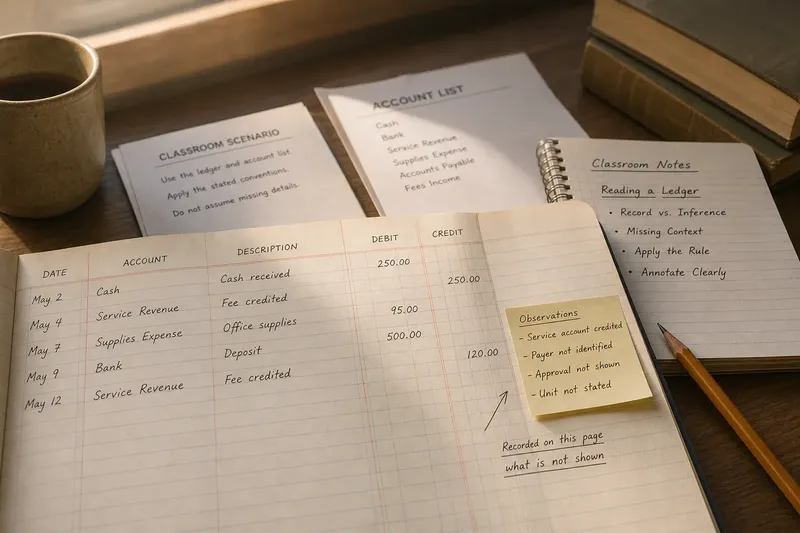
The common mistake with a ledger page classroom example is to treat its columns as the transaction itself. A date, account name, debit, and credit record selected details; they do not supply every circumstance behind an entry. The cost is an interpretation that sounds certain while relying on facts the page never gives.
At the Banking Academy (BA), a ledger can serve as a teaching form: its columns make accounting relationships visible, while instructions, participants, and uncertainty may sit elsewhere. Read it as a classroom representation of accounting conventions, not as a miniature account of every circumstance behind an entry.
What does a ledger page actually show?
- Sequence: Check whether dates or posting references appear. If they do, use them to follow the record; if they do not, avoid claiming an order the page cannot establish.
- Account classification: Check whether the exercise defines its account labels. If it does, apply that convention; if it does not, consult the supplied account list or leave the classification unresolved.
- Debit and credit relationship: Check for accounting rules in the prompt. If rules are stated, read the columns through them; if not, avoid translating the labels automatically into everyday ideas such as “money in” or “money out.”
- Amounts: Check whether a heading names a unit or currency. If it does, retain that information in your interpretation; if it does not, leave the unit unspecified and look for an accompanying note.
- Comparability: Compare repeated rows for changes in dates, labels, or entries. If a difference appears, identify it; if its significance is unclear, check the exercise rules before calling it an error.
A ledger makes structure visible, not motive.
How do columns shape a classroom reading?
A column is a small argument about what belongs together. Account names beside debit and credit fields direct attention toward classification and balance; a description field also invites attention to what the entry says happened.
Read across a row to connect its date, account, description, and amount. Read down a column to compare dates or entries assigned to one account. Both approaches help, but neither answers every question the page raises.
Say you are given an invented classroom exercise with a ledger containing date, account, description, debit, and credit columns. One row says a fee was credited to a service account, while the prompt supplies account names but does not identify the payer or an approving instruction. You check the row against the prompt, preserve its wording, and write a separate note: “Payer and approval not stated.” The result is a readable entry with its limits visible, rather than a story completed by guesswork.
What stays outside the ledger?
- Participants: Check whether the row names people or organizations as well as accounts. If it does not, describe only the accounts; if responsibility or relationships matter, consult a case prompt or supporting form.
- Purpose: Check whether a description explains the reason for the entry. If it does, use the stated reason; if it does not, do not treat an account label as an explanation and look for a case note.
- Authority: Check for an approval or governing instruction. If one is shown, cite it accurately; if none is shown, do not infer authorization and check any accompanying instruction.
- Source: Check whether the page identifies who prepared it or what information informed it. If it does, note that source; if it does not, leave the source unspecified or consult the exercise materials.
- Uncertainty: Check whether the scenario leaves a detail ambiguous. If the prompt resolves it, apply that clarification without rewriting the original entry; if it does not, record the ambiguity.
These absences are not automatically defects. A teaching ledger is selective by design; trouble starts when students mistake selection for completeness.
How can students annotate without clutter?
Keep the formal fields intact and place interpretation beside them, not inside them. A margin note, separate observation column, or short caption can distinguish what the page records from what the reader infers. Changing an account label to make a scenario “clearer” may change the exercise rather than explain it.
For each row, check the following and make the decision indicated by what you find:
- Recorded detail: Check whether the detail appears directly in the row. If it does, quote or paraphrase it in the observation; if it does not, do not present it as recorded and label any supported conclusion as an inference.
- Inference: Check whether an exercise rule supports your conclusion. If it does, mark the conclusion as an inference; if it does not, leave the conclusion open and seek clarification if the assignment requires one.
- Missing context: Check whether a relevant detail is absent from the ledger. If it is absent, name the precise gap; if it appears in another supplied document, cite that document instead of calling the detail missing.
- Available clarification: Check the prompt, account list, instructor note, and supporting forms for a rule that resolves the question. If one does, use it; if none does, preserve the uncertainty in your annotation.
- Original entry: Check whether the row is legible and complete under the course convention. If it is, leave it unchanged; if a correction is required, show it separately according to the stated convention.
- Amount meaning: Check whether the heading specifies a unit or currency. If it does, retain that detail; if it does not, do not supply one by assumption and consult the prompt if the unit matters.
“Service account credited” may be recorded, while “payment received from a customer” is an inference unless the prompt supplies that fact. “Payer not identified on this page” is more precise than inventing a customer to complete the story.
How should you read a classroom ledger?
- Read the headings first. Identify the fields and any stated units or abbreviations. If a label is unclear, consult the prompt or account list before interpreting the rows.
- Read a full row. Connect its date, account, description, and amounts. If a figure seems significant on its own, check the rest of its row before assigning meaning.
- Trace the stated rule. Apply the accounting convention supplied for the exercise. If no convention is stated, mark it unresolved rather than substituting an everyday meaning.
- Separate record from inference. Note what appears directly and what follows from the stated rule. If the page does not support a conclusion, leave the gap visible.
- Consult neighboring material. Compare the ledger with a transaction form, case prompt, instructor note, or account list when supplied. If none is provided, limit your claim to what the ledger itself shows.
- State what remains unanswered. Name the specific limit, such as an unnamed payer or unspecified unit. If later material resolves it, update the interpretation without disguising what the ledger originally omitted.
This reading order keeps the ledger useful without treating it as a complete narrative.
Which ledger details do students often misread?
Does a debit always mean money left the account?
No. Debit and credit are accounting terms whose effects depend on account type and the conventions in use. Read them through the exercise rules rather than translating them automatically into everyday language.
Does a balanced entry prove the transaction was correct?
It shows that the recorded sides meet the relevant balancing condition; it does not establish that the account choice, description, authority, or source is correct. A balanced page can still contain a mistaken classification or an omitted fact.
Why can two classroom ledgers use different columns?
Forms serve particular instructional purposes, so one exercise may separate details that another combines. Compare the headings and instructions before comparing rows; similar-looking pages may ask students to do different work.
Should students add missing context directly to a ledger?
Usually, preserve the original entry and put interpretation in a distinct note or companion field. If the course provides an annotation convention, follow it so observation and alteration remain distinguishable.
What should a ledger page classroom example teach?
A useful ledger page classroom example teaches students to see both the power and the boundary of a form. Columns make an entry legible by sorting information into a repeatable arrangement; that sorting can leave participants, purpose, authority, and uncertainty elsewhere. Read the page alongside its prompt and supporting documents, rather than asking it to do every job.
When you build or study a ledger page, ask what the layout lets you say and what would require another source. In BA coursework, a separate note naming an unresolved detail can be more informative than a polished row that quietly assumes an answer.